
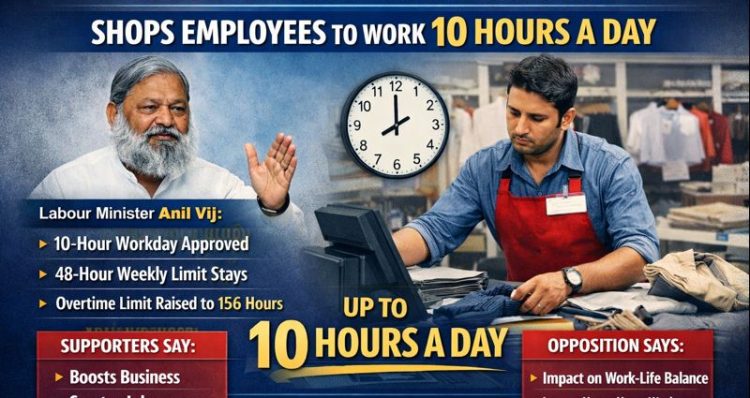
Haryana Shop Employees May Work Up to 10 Hours Daily Under New Law
Dubai | December 26, 2025 | 3 | India , newsShop and private commercial establishment employees in Haryana may soon have to work up to 10 hours a day after the state Assembly passed a key labour reform bill during its winter session.
The legislation keeps the weekly working limit capped at 48 hours, while allowing greater flexibility in daily schedules.
Haryana Shops and Commercial Establishments Amendment Bill, 2025 Passed
The Haryana Shops and Commercial Establishments (Amendment) Bill, 2025 was approved to revise provisions of the Haryana Shops and Commercial Establishments Act, 1958.
The Bill increases:
-
Daily working hours from 9 to 10 hours
-
Quarterly overtime limit from 50 hours to 156 hours
-
Continuous working hours without rest from 5 to 6 hours
According to the government, these changes aim to support economic growth while protecting workers’ rights.
Labour Minister Anil Vij Defends the Bill
Labour Minister Anil Vij said the amendments are designed to reduce compliance pressure on small businesses, promote ease of doing business, and generate new employment opportunities.
He stressed that:
-
The 48-hour weekly limit remains unchanged
-
Longer daily hours will help businesses manage peak demand, staff shortages, and emergencies
-
The law benefits both workers and traders
Vij added that similar labour provisions already exist in states such as Maharashtra, Punjab, Telangana, Andhra Pradesh, and Odisha.
Overtime Limit Increased to Meet Business Needs
One of the major changes under the Bill is the increase in permissible overtime work.
-
Overtime per quarter rises from 50 hours to 156 hours
-
This allows establishments to handle seasonal or high-demand workloads more efficiently
The government said overtime rules will still apply under existing labour protections.
Opposition Raises Concerns Over Worker Welfare
Congress MLA Aditya Surjewala strongly opposed the Bill, calling some provisions harmful to workers’ personal and family life.
Key Objections Raised
-
Increase in daily working hours to 10 hours
-
Higher overtime limits, which could result in up to 12-hour workdays
-
Concerns over work-life balance and employee well-being
Surjewala questioned whether the Bill promotes ease of doing business or legalises “modern-day slavery.”
An amendment proposed by the Congress to retain the nine-hour daily limit was rejected by voice vote in the Assembly.
Small Establishments Get Compliance Relief
A major reform under the Bill is the increase in the registration threshold.
-
Only establishments with 20 or more employees will now require registration
-
Businesses with fewer than 20 workers will only need to provide an intimation, not a registration certificate
According to Minister Vij, this move will:
-
Reduce fear of regulatory action
-
Encourage job creation
-
Ease compliance for small traders and shop owners
However, the opposition argued that this could exclude over 80% of shops from labour law coverage.
Alignment With Other Indian States
Vij said Haryana’s labour reforms are in line with policies in several other states where:
-
10-hour workdays are permitted
-
Registration applies only to establishments with 20 or more workers
This, he said, ensures uniformity and competitiveness across states.
Other Bills Passed in Haryana Assembly
The Amendment Bill was among eight legislations cleared on the final day of the Haryana Vidhan Sabha’s winter session.
Other key Bills included:
-
Haryana Private Universities (Amendment) Bill, 2025
-
Haryana Abadi Deh Ownership Rights Bill, 2025
-
Haryana Jan Vishwas (Amendment of Provisions) Bill, 2025
The Jan Vishwas Bill focuses on decriminalisation of minor offences, replacing criminal penalties with civil and administrative actions to promote trust-based governance and ease of living.
Conclusion
The passage of the Haryana Shops and Commercial Establishments Amendment Bill, 2025 marks a significant shift in the state’s labour framework. While the government views it as a step toward economic flexibility and business growth, the opposition continues to raise concerns about worker welfare and work-life balance.
As the law comes into effect, its real impact on employees and small businesses will be closely watched.
Related Posts

India’s New AI IT Rules 2026:…
Dubai | February 20, 2026 | 4India’s government has officially enforced new IT rules for AI-generated content starting today. These updated regulations fall under the Information Technology (Intermediary Guidelines and Digital Media Ethics Code) Rules, 2021,…

USD 3bn HPCL–Abu Dhabi LNG Deal…
Dubai | February 10, 2026 | 10Major India–UAE Energy Deal Strengthens Long-Term LNG Supply Leading law firms Shardul Amarchand Mangaldas & Co (SAM) and Holman Fenwick Willan (HFW) have advised on a USD 3 billion long-term…