
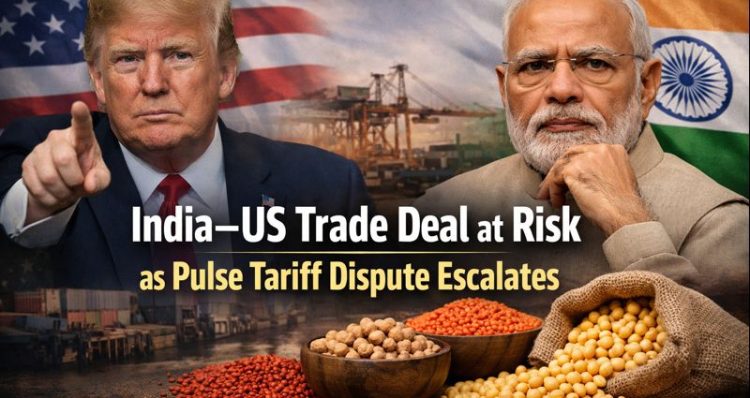
India–US Trade Deal at Risk as American Farmers Oppose Pulse Import Duty
Dubai | January 19, 2026 | 2 | India , newsTalks on the India–US trade agreement may face new hurdles as pulses have emerged as a fresh point of conflict. Two senior US lawmakers have urged President Donald Trump to press India to withdraw its 30 percent import duty on American pulses, claiming the tariff puts US farmers at a major disadvantage in the Indian market.
US Lawmakers Raise Concerns Over India’s Tariff Move
Republican Senators Steve Daines from Montana and Kevin Cramer from North Dakota have written a letter to President Trump highlighting the impact of India’s recent tariff decision. According to them, the duty has created an unfair trade barrier for American pulse exporters.
India introduced the 30 percent tariff on yellow peas on October 30, 2025, and it officially came into effect on November 1, 2025. The decision followed the Trump administration’s earlier move to impose 50 percent punitive tariffs on Indian goods, further escalating trade tensions between the two nations.
Why Pulses Matter in India–US Trade Relations
India: The World’s Largest Pulse Consumer
India is the largest consumer of pulses globally, accounting for nearly 27 percent of total world consumption. Staples such as lentils, chickpeas, dried beans, and peas are essential parts of the Indian diet. However, high import duties have reduced the competitiveness of US-grown pulses in this massive market.
Impact on American Farmers
The US senators argued that farmers in Montana and North Dakota—America’s top pulse-producing states—are facing serious economic losses. The letter stated that due to India’s tariff policy, American producers are unable to compete with suppliers from other countries offering pulses at lower prices.
They described the tariffs as “unfair and restrictive,” adding that removing them would benefit both American growers and Indian consumers by ensuring better supply and stable prices.
Call for Stronger Economic Cooperation
Request for Trump–Modi Engagement
The lawmakers encouraged President Trump to directly discuss the issue with Prime Minister Narendra Modi as part of the broader trade negotiations. They believe that resolving the pulse tariff dispute would help strengthen bilateral economic ties and create a more balanced trade relationship.
The senators also appreciated Trump’s past efforts to support US agriculture and recalled that during his first term, he had personally delivered a similar letter to PM Modi ahead of the 2020 trade talks, which helped bring pulse producers into negotiations.
US Farmers Ready to Meet Global Demand
In their communication, the senators emphasized that American farmers have the capacity to feed global markets if trade barriers are removed. They urged the US administration to ensure that any future trade deal with India includes favorable provisions for pulse exports.
Background of the Trade Dispute
Trade tensions between India and the US have been ongoing since June 2019, when India was removed from the Generalised System of Preferences (GSP). Following this, additional duties were imposed on several American products, including pulses.
The latest tariff on yellow peas has once again brought the issue to the forefront, raising concerns that it could delay or derail the proposed India–US trade agreement.
Conclusion
The dispute over pulse tariffs has become a key challenge in India–US trade negotiations. While the US seeks greater market access for its farmers, India aims to protect domestic producers and maintain price stability. How both nations handle this sensitive issue will play a crucial role in shaping the future of their strategic and economic partnership.
Related Posts

India’s New AI IT Rules 2026:…
Dubai | February 20, 2026 | 2India’s government has officially enforced new IT rules for AI-generated content starting today. These updated regulations fall under the Information Technology (Intermediary Guidelines and Digital Media Ethics Code) Rules, 2021,…

USD 3bn HPCL–Abu Dhabi LNG Deal…
Dubai | February 10, 2026 | 5Major India–UAE Energy Deal Strengthens Long-Term LNG Supply Leading law firms Shardul Amarchand Mangaldas & Co (SAM) and Holman Fenwick Willan (HFW) have advised on a USD 3 billion long-term…