
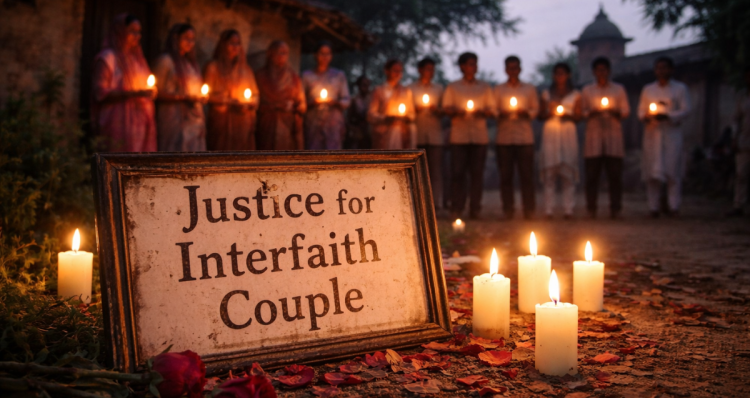
Interfaith Couple Killed in UP Village, Honour Killing Suspected
Dubai | February 4, 2026 | 7 | India , newsA Quiet Village in Shock
A small village in northern Uttar Pradesh is struggling to come to terms with a brutal crime that has disturbed years of communal harmony. Residents of Umri village, located about 182 km from New Delhi, say they never expected such violence in a place where Hindus and Muslims have lived peacefully for generations.
The discovery of the bodies of an interfaith couple has left the village in silence and grief.
Bodies Found Near Riverbank
The bodies of 19-year-old Kajal, a Hindu woman, and 27-year-old Mohammad Arman, a Muslim man, were found buried near a riverbank on the outskirts of Umri on 21 January. Police say the couple was allegedly beaten to death with a spade two days earlier.
According to investigators, Kajal’s three brothers have been arrested in connection with the murders. Police believe the crime was motivated by “honour killing”, a term used for violence against individuals who choose partners outside their caste or religion.
Police Call It an Honour Killing
Deputy Inspector General of Police Muniraj G told the BBC that early findings point to an honour-based crime. Such killings are treated as murder under Indian law, and courts have repeatedly upheld an adult’s constitutional right to choose a partner.
Official records show that honour killings remain underreported. While India’s National Crime Records Bureau listed 38 cases in 2023, activists argue the real number is much higher, with many cases recorded simply as homicide.
Village With No History of Religious Conflict
Umri village, home to around 400 families, has no known history of religious violence or disputes. Many villagers said Kajal and Arman were the first known interfaith couple in the area.
“They lived just 200 metres apart,” said one resident. Villagers described the couple as quiet and reserved, with few close friends.
The region, part of Moradabad district, is largely rural and shaped by deep-rooted social hierarchies, which continue to influence family and community decisions.
Details of the Relationship
Kajal worked as a teacher at a private school, while Arman had recently returned from Saudi Arabia, where he had worked for four years. After coming back, he found work with a local stone-crushing contractor.
Police say the two were close, though it is unclear how long the relationship lasted. Investigators allege that the killings took place inside Kajal’s home on the night of 18–19 January, when her brothers allegedly found Arman there.
Conflicting Accounts From Families
Kajal’s father, Ganpat Saini, said he and his wife were away guarding livestock on the night of the incident. He claimed he only learned about the killings after the bodies were recovered and said he was grieving his daughter’s death.
Arman’s family also said they were unaware of the relationship. His brother, Farman Ali, said Arman left home that evening saying he was going to buy medicine and never returned. A missing complaint was filed the next morning.
Police allege that Kajal’s brothers later filed a false missing report, accusing Arman of abducting her, in an attempt to mislead investigators.
Heavy Police Presence, Lingering Silence
Following the incident, police were deployed in Umri to prevent any communal tension. While daily life is slowly returning to normal, residents say a sense of unease remains.
“We never imagined something like this could happen here,” said one villager. “There is no open fear, but the silence feels heavy.”
A Broader Social Problem
Across India, more than 93% of marriages are arranged within the same caste and religion. Couples who choose differently often face social pressure, threats, or violence, and many seek protection from courts or police.
In 2018, India’s Supreme Court ordered states to create safe houses for interfaith and inter-caste couples. Despite this, honour-related violence continues to be reported.
Activists Call for Social Change
Human rights activists say the problem goes beyond law enforcement. Kavita Srivastava, a rights advocate, argues that underreporting leads to official indifference.
“When the scale of the problem is not acknowledged, it cannot be addressed,” she said.
Filmmaker Nakul Singh Sawhney, who has studied the issue, added that the honour killing motive often emerges late in investigations, keeping many cases out of official data.
Conclusion: A Village Forced to Reflect
The killings of Kajal and Arman have become another tragic reminder of the risks faced by interfaith couples in India. While laws exist to protect individual choice, experts say deeply ingrained social attitudes continue to fuel violence.
For Umri village, the incident has left behind not just grief—but a painful reflection on how love can still cost lives in modern India.
Related Posts

India’s New AI IT Rules 2026:…
Dubai | February 20, 2026 | 2India’s government has officially enforced new IT rules for AI-generated content starting today. These updated regulations fall under the Information Technology (Intermediary Guidelines and Digital Media Ethics Code) Rules, 2021,…

USD 3bn HPCL–Abu Dhabi LNG Deal…
Dubai | February 10, 2026 | 5Major India–UAE Energy Deal Strengthens Long-Term LNG Supply Leading law firms Shardul Amarchand Mangaldas & Co (SAM) and Holman Fenwick Willan (HFW) have advised on a USD 3 billion long-term…