
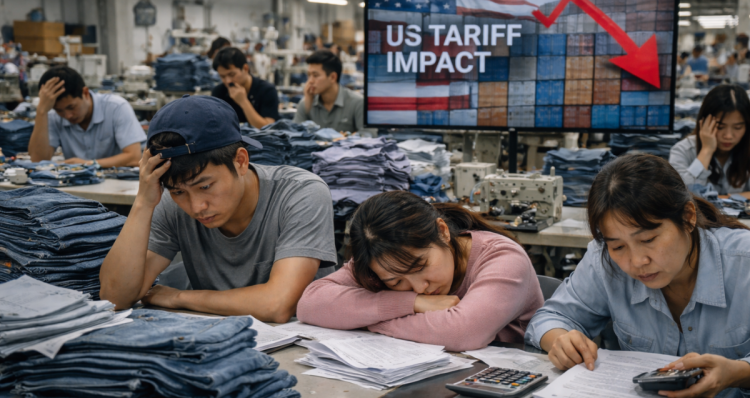
Asian Firms Struggle After US Tariff Ruling
Dubai | February 26, 2026 | 0 | Business , newsAsian exporters and manufacturers are facing renewed uncertainty following the US Supreme Court ruling that invalidated a key component of former President Donald Trump’s tariff regime. Despite initial expectations, the decision has not brought relief to companies across the region.
Supreme Court Ruling Creates Confusion
The court struck down the emergency powers law that Trump used to impose tariffs, effectively nullifying billions of dollars in levies. Within hours, Trump issued an executive order implementing a 10% global tariff, with the possibility of increasing it to 15%.
Businesses, particularly in China, Thailand, and Singapore, now face challenges navigating shifting trade regulations, which affect pricing, supply chains, and investment decisions.
Push Sharma, founder of Singapore-based wellness brand Haldy, explained, “We had completed trademark registrations and planned market entry, but uncertainty forced us to defer our US launch.”
Impact on Pricing and Operations
Asian manufacturers have seen costs rise since the initial tariffs in 2025. Tomi Mäkelä, general manager of Thailand’s Lanna Clothing, said clients frequently renegotiated or canceled orders, forcing price adjustments.
Sharma noted, “If you don’t know your final costs, pricing becomes very difficult. The cost of doing business is unpredictable.”
Lynsey Lim, founder of Singapore skincare brand Handmade Heroes, said companies are now focusing on efficiency and diversification, rather than just pricing strategies.
Supply Chain Challenges
Logistics firms like DHL report that businesses are now navigating a more complex operating environment. While some tariffs have been halted, others remain in effect, leaving operational questions unresolved.
Niki Frank, CEO of DHL Global Forwarding Asia-Pacific, said, “It is too early to assess potential refunds or shipping volume impacts. Supply chains adjust slowly, and tariffs are only one part of the decision-making context.”
Similarly, FedEx has filed a lawsuit seeking full refunds for emergency tariffs paid under Trump’s original policy.
China Remains Central to Asian Manufacturing
Despite changing US policies, China continues to dominate manufacturing in Asia. Tariffs tied to country-of-origin rules still apply, making it difficult for companies to avoid Chinese supply chains.
Sharma explained, “Even with diversification, if it’s made in China, a 25% tariff applies. We rely on China for production and packaging.”
Tomi Mäkelä added, “China can produce at scale more efficiently and cheaply than competitors. This keeps other Asian exporters under pressure.”
Businesses Adjust Strategies and Markets
Many companies are shifting focus away from the US to reduce risk. Haldy has expanded retail operations in Malaysia and is exploring the Middle East. Lanna Clothing is targeting Canada, Australia, and Europe for new customers.
Future Uncertainty Looms
Trump’s upcoming visit to China in late March may further influence tariff policy and regional trade dynamics. Analysts warn that while immediate tariff burdens may ease, sector-specific risks and uncertainty remain.
Reema Bhattacharya, head of Asia research at Verisk Maplecroft, said, “Asian exporters may benefit from lower global rates, but the legal shifts create uncertainty and could introduce targeted trade measures.”
For companies and governments alike, the only certainty is that uncertainty will continue to shape Asian trade and global supply chains in 2026.
Related Posts

Reval 26 Halt Sparks Legal Challenge…
Dubai | February 19, 2026 | 2Reval 26 Pause Sparks Legal and Political Debate A major disagreement over business rates reform in Northern Ireland has placed Finance Minister John O'Dowd in a difficult position. The minister…

Rice University Adds Marketing Concentration
Dubai | February 13, 2026 | 0Rice University’s Virani Undergraduate School of Business has announced the launch of a new marketing concentration, expanding its undergraduate business major and offering students more opportunities to shape their academic…