
Why Political Change in Iran Could Harm India but Help Pakistan and China
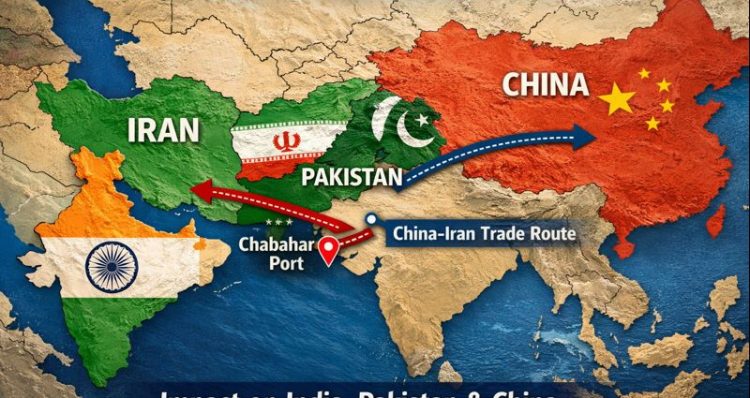
Dubai | January 15, 2026 | 2 | India , newsIndia is closely monitoring the political uncertainty in Iran with growing concern. Any major regime change in Iran could disturb India’s strategic interests in West Asia, while offering new advantages to Pakistan and China. For decades, Iran has played a key role in India’s regional diplomacy, trade routes, and security planning.
A weakened Iranian state could reduce India’s influence in the region, which is already under pressure due to instability in Bangladesh, cross-border terrorism from Pakistan, and China’s expanding footprint.
Iran’s Strategic Importance for India
Chabahar Port – India’s Gateway to Central Asia
One of the most crucial pillars of India-Iran relations is the Chabahar Port project. Since Pakistan blocks India’s land access to Afghanistan and Central Asia, Iran provides the only practical western corridor for Indian trade.
-
Chabahar allows India to bypass Pakistan
-
Connects India to Afghanistan, Uzbekistan, and Central Asia
-
Supports India’s energy and trade security
However, experts warn that any political instability in Tehran could put this project at risk. Without a stable government, long-term infrastructure commitments may collapse.
A regional analyst noted that in a post-crisis Iran, Chabahar could become a victim of internal power struggles rather than remain a strategic asset for India.
Iran as a Counterbalance to Pakistan
Historically, Iran has helped India maintain a strategic balance against Pakistan. Despite being a Muslim-majority nation, Iran’s Shia leadership has opposed Sunni extremist groups operating from Pakistan.
During the 1990s and early 2000s:
-
Iran and India jointly supported anti-Taliban forces in Afghanistan
-
Tehran resisted Pakistan’s efforts to isolate India on Kashmir
-
Iranian diplomacy limited Pakistan’s dominance in Kabul
If Iran weakens, this counterweight to Pakistan will fade, giving Islamabad greater influence over Afghanistan and regional politics.
Economic Stakes for India
Bilateral Trade and Investments at Risk
India is Iran’s eighth-largest trading partner, with annual trade valued between $1.3 to $1.7 billion. India has also invested more than $1 billion in Chabahar and related infrastructure.
Any sudden regime change could:
-
Endanger Indian investments
-
Disrupt energy imports
-
Force India to comply with new sanctions
-
Delay connectivity projects
Indian taxpayers and businesses would directly feel the impact if contracts are cancelled or renegotiated.
China’s Growing Advantage in Iran
Beijing’s Expanding Footprint
While India struggles with sanctions and diplomatic limitations, China has rapidly increased its presence in Iran. The two nations signed a 25-year strategic cooperation agreement in 2021.
Key facts:
-
China was Iran’s largest trade partner in 2025
-
Over $14.5 billion worth of Iranian exports went to China
-
Beijing buys discounted Iranian oil
-
Chinese firms fund ports, power plants, and rail projects
If instability continues, any new Iranian leadership is likely to depend even more on China for economic survival, further reducing India’s influence.
What Should India Do Next?
Former Indian diplomat Nirupama Menon Rao believes India must adopt a careful and neutral approach. According to her:
-
India should avoid taking sides
-
Protection of Indian citizens must be the top priority
-
Diplomatic channels with all factions should remain open
-
Contingency plans for evacuation and trade disruption are essential
She warned that prolonged chaos in Iran could affect:
-
Global energy prices
-
Shipping routes
-
Indian diaspora in West Asia
-
Growth of militant networks
India must focus on preparedness rather than political posturing.
Conclusion
Iran remains a vital strategic partner for India, but the current uncertainty threatens decades of diplomatic and economic investment. While India risks losing access, influence, and trade routes, Pakistan and China could emerge as the biggest beneficiaries.
New Delhi’s challenge will be to protect its interests without getting drawn into Iran’s internal conflict. A policy of strategic caution, steady engagement, and regional balance will be crucial in the coming years.
Related Posts
India’s New AI IT Rules 2026:…
Dubai | February 20, 2026 | 0India’s government has officially enforced new IT rules for AI-generated content starting today. These updated regulations fall under the Information Technology (Intermediary Guidelines and Digital Media Ethics Code) Rules, 2021,…

USD 3bn HPCL–Abu Dhabi LNG Deal…
Dubai | February 10, 2026 | 0Major India–UAE Energy Deal Strengthens Long-Term LNG Supply Leading law firms Shardul Amarchand Mangaldas & Co (SAM) and Holman Fenwick Willan (HFW) have advised on a USD 3 billion long-term…