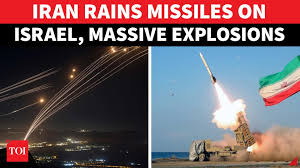
The fragile peace in West Asia completely shattered early Monday morning as Israel and Iran engaged in their largest, most violent direct military crossfire since a UN-backed ceasefire was brokered in early April. The dramatic escalation began overnight when Iran’s Islamic Revolutionary Guard Corps (IRGC) launched consecutive waves of advanced ballistic missiles targeting key Israeli defense positions, including the strategic Nevatim and Tel Nof air bases. Tehran claimed the massive bombardment was an act of mandatory self-defense following recent Israeli airspace violations and unannounced targeted strikes on the southern suburbs of Beirut. In immediate retaliation, the Israeli Air Force launched a series of high-altitude precision airstrikes deep inside Iranian territory, lighting up the night sky over major urban centers including Tehran, Tabriz, Isfahan, and a vital petrochemical manufacturing complex in the southwestern city of Mahshahr. The rapid, unmitigated violence immediately triggered a severe domino effect across neighboring territories, with Jordan, Iraq, and Syria enacting emergency airspace closures, while Yemen’s Houthi rebels officially entered the fray by launching a complementary missile barrage at central Israel and declaring a total, absolute ban on all Israel-affiliated maritime shipping throughout the Red Sea. Meanwhile, international diplomatic channels have fallen into absolute chaos; while Qatari Prime Minister Sheikh Mohammed bin Abdulrahman Al Thani rapidly initiated emergency mediation calls with Iranian Foreign Minister Abbas Araghchi, United States President Donald Trump firmly asserted in a Financial Times interview that Israeli Prime Minister Benjamin Netanyahu would ultimately have “no choice” but to accept whatever eventual diplomatic nuclear layout Washington dictates, adding a highly unpredictable layer to the global crisis.
Middle East War Reignites as Israel and Iran Exchange Heavy Airstrikes and Ballistic Missile Barrages